Dress & arms
Templar uniform, clothing, equipment & weapons
The Order of the Temple was both a monastic community and a professional heavy cavalry force. Its brothers dressed accordingly — mail and surcoat on campaign, the white woollen habit at prayer, working tunics on the granges. The illustrations below follow the Templars through the four settings that shaped their day, drawn from the Latin Rule of 1129, the later French Retrais, the Order's own inventories and the standard modern scholarship of Malcolm Barber and Helen Nicholson.
In the field
The battle knight
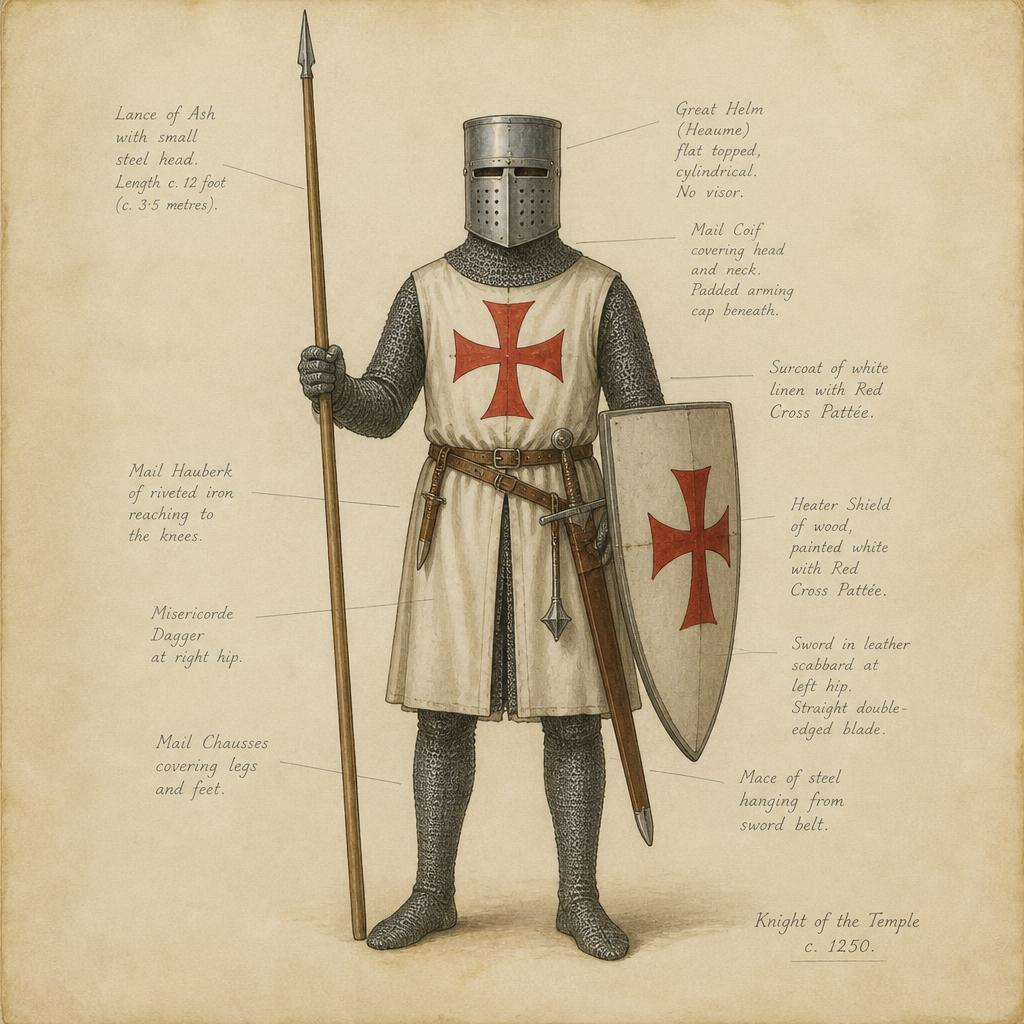
On campaign a knight-brother wore the full harness of a heavy Western cavalryman. The Rule of the Templars (the Latin Primitive Rule of c.1129 and the later French Retrais) prescribed the equipment down to the last strap.
- Body armour
- A knee-length iron mail hauberk with integral or separate mail coif, worn over a padded linen or quilted gambeson (haubergeon). Mail chausses covered the legs, laced at the back.
- Helm
- Through the twelfth century a conical nasal helm was standard. By the early thirteenth century the flat-topped great helm (heaume) had appeared, worn over the coif and an arming cap.
- Surcoat
- A white linen or wool surcoat worn over the mail — from Pope Eugenius III's grant in 1147 it bore the splayed red cross (croix pattée) on the breast and, later, on the back.
- Shield
- Early twelfth-century knights carried the long kite shield; by c.1200 this had shortened into the heater shield, painted white with the red cross or with the Order's black-and-white Beauséant.
- Primary arms
- A single-handed arming sword with wheel or brazil-nut pommel, a lance of ash roughly 3.5 m long, a dagger (misericorde) and a mace or war-hammer for close work against armoured opponents.
- Horses
- The Rule allowed each knight three warhorses and a pack animal, tended by a squire. The destrier was ridden only in the charge; a rouncey or palfrey carried him on the march.
On the road
Travelling and estate business
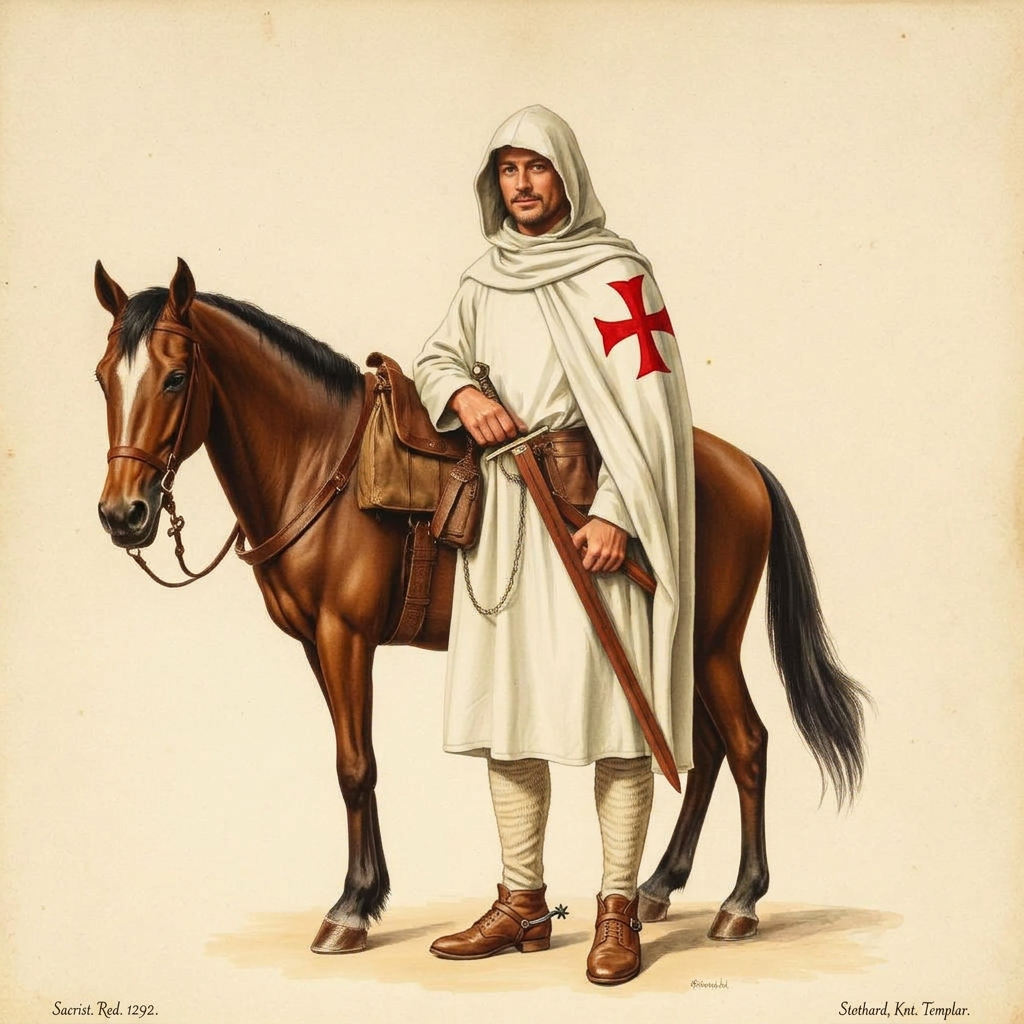
Most Templars in the Latin West never saw the Holy Land. Brothers moving between preceptories — collecting rents, escorting silver, or riding to a general chapter — travelled in the religious habit, not in armour.
- The mantle
- Knight-brothers wore a white woollen mantle (mantel) with the red cross on the left shoulder, over an undyed linen or wool tunic and hose. The Rule forbade any fur except lambskin.
- Riding kit
- A hood (chaperon) and heavy travelling cloak against Welsh and Marcher weather, sturdy leather boots with prick spurs, and a satchel or scrip for documents and cash.
- Arms carried
- A sword and dagger at the belt were expected for self-defence on the road, but the great helm, shield and lance stayed at the preceptory unless the brother was riding to war.
- Companions
- The Rule ordered that no brother travel alone. A knight was accompanied by a sergeant or squire, and often by a chaplain-brother on visitations of the Order's churches.
In the preceptory
Daily religious life
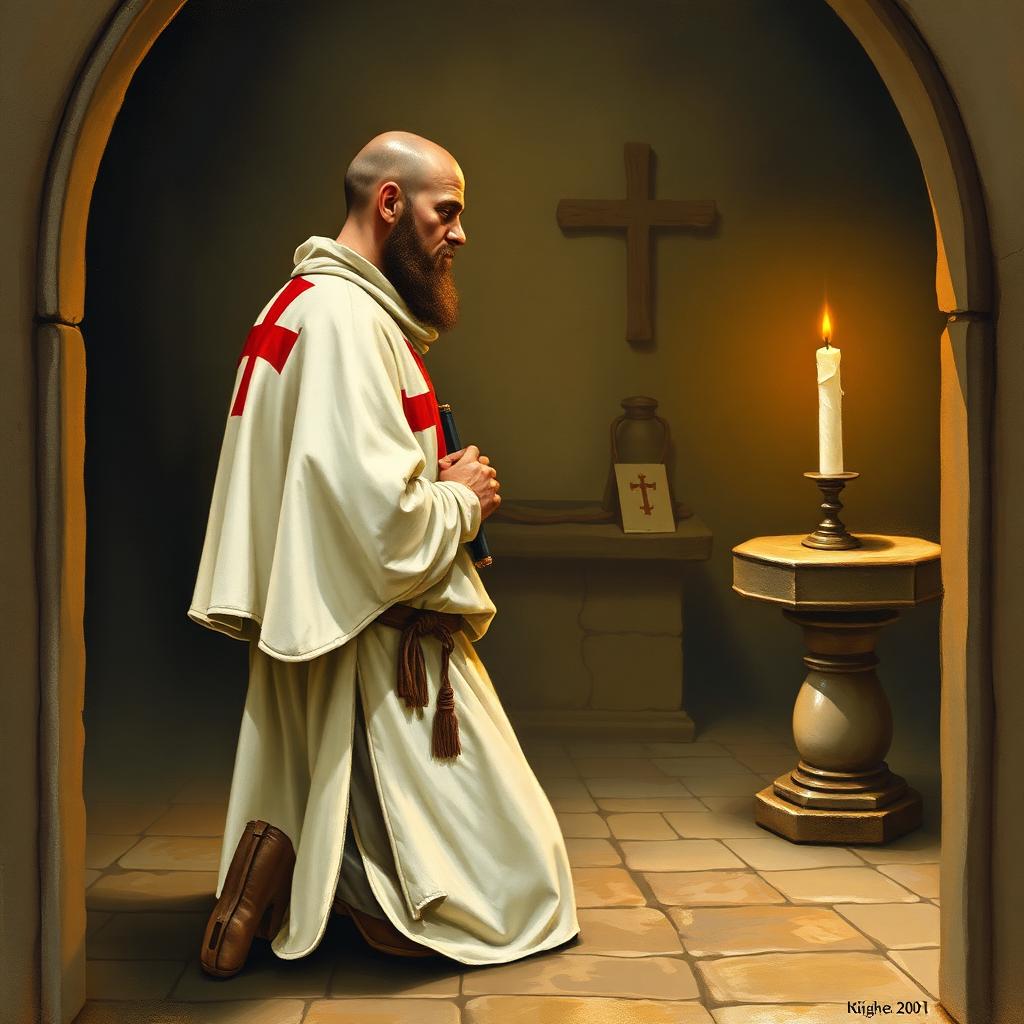
The Templars were, first, a religious order following an adaptation of the Cistercian observance. Inside the preceptory a knight-brother looked far more like a monk than a soldier.
- Habit
- A plain white woollen habit (robe) with hood, cinched by a knotted cord or leather belt, worn under the mantle. The colour signified purity and separation from the world.
- Tonsure and beard
- The Rule required a clerical tonsure of the crown and — unusually for Latin monastics — a full beard, marking the brothers out from secular clergy.
- Devotional items
- A wooden or knotted-cord paternoster (rosary), a small pectoral or belt cross, and a personal breviary or psalter for illiterate brothers to follow the offices.
- Prohibitions
- No pointed shoes, no laced garments, no long hair, no personal jewellery, no locked chests. Meals were taken in silence in the refectory, with meat allowed three times a week.
On the estates
Sergeants, farmers and craftsmen
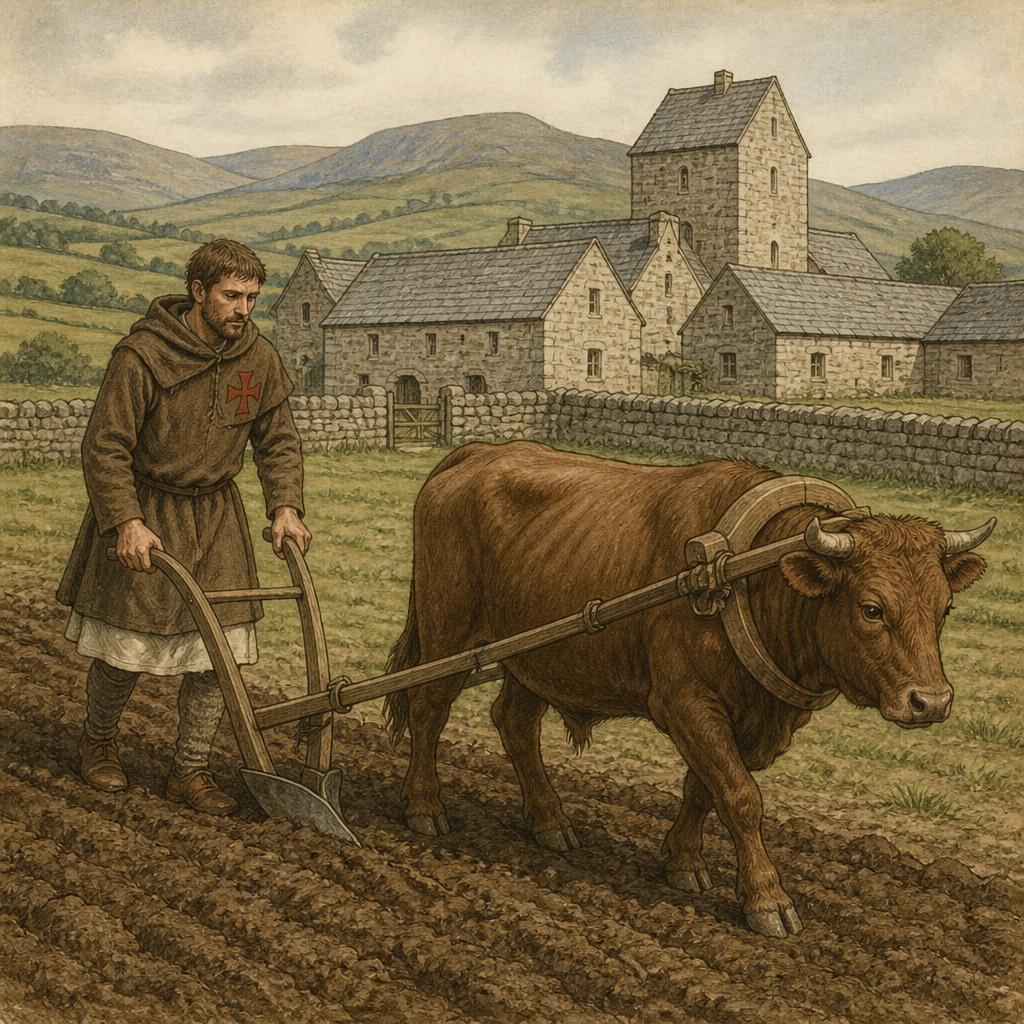
The majority of Templars in Britain were sergeants (frères sergents), not knights. They ran the Order's farms, mills, granges and quays — including the great commandery estates at Slebech in Pembrokeshire and Llanmadoc on Gower.
- Sergeant's habit
- From 1147 sergeants were required to wear a black or brown mantle and tunic, distinguished from the knights' white. The same red cross was displayed, usually smaller, on the breast.
- Working dress
- For field work the mantle was set aside. A short woollen tunic, undyed linen shirt, coarse hose and stout leather boots or ankle shoes were standard, with a hood against the weather.
- Tools
- The same iron tools as any Welsh manor: plough shares, scythes, sickles, spades, billhooks, shepherds' crooks. Preceptory forges also produced horseshoes, nails and repair ironwork.
- Roles
- Sergeants served as ploughmen, shepherds, foresters, smiths, cellarers and, when needed, as light cavalry. The Rule granted them one horse in peacetime and two on campaign.
Reference plates
Two overhead plates gathering the individual pieces of a knight-brother's harness and habit. Every element shown is documented in the Templar Rule or in surviving thirteenth-century inventories of the military orders.
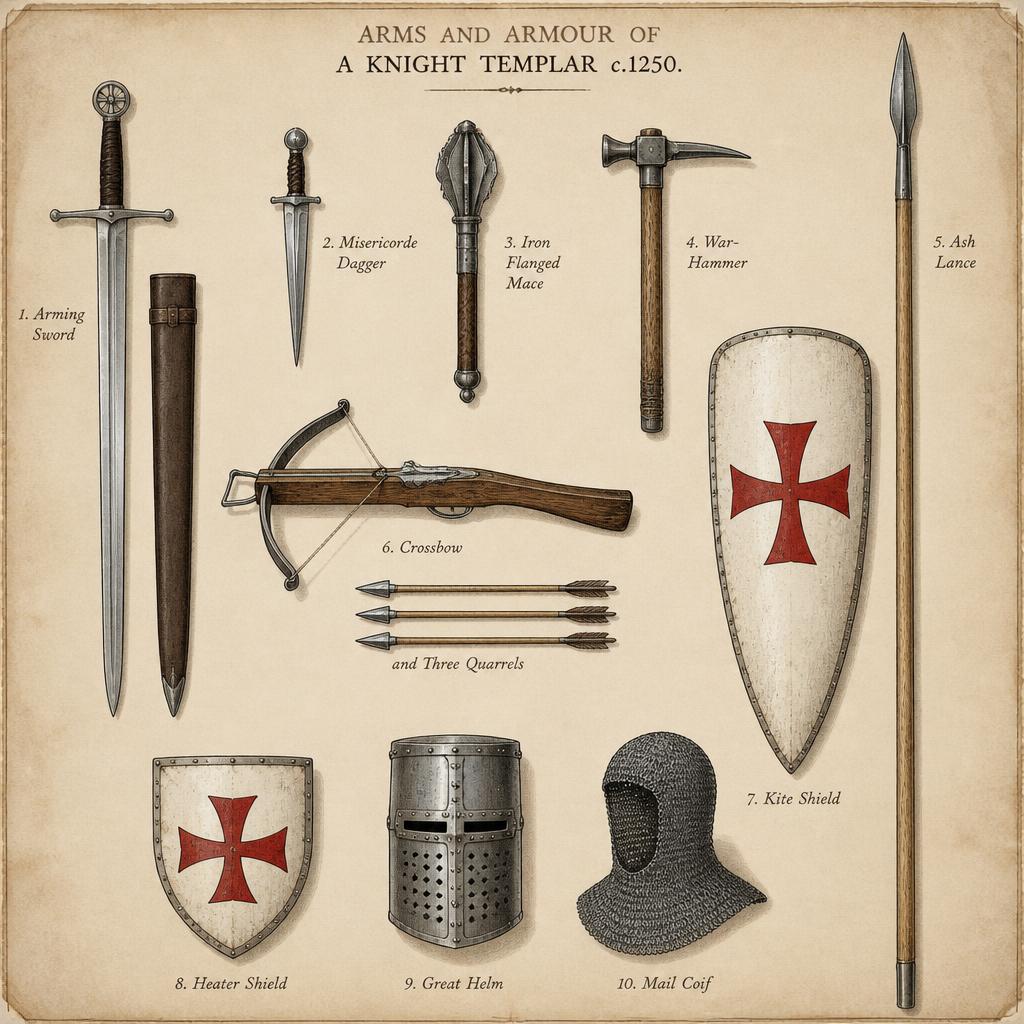
Arming sword, dagger, mace, war-hammer, lance-head, crossbow, kite and heater shields, great helm and mail coif — the standard field equipment recorded in the Order's Rule and inventories.
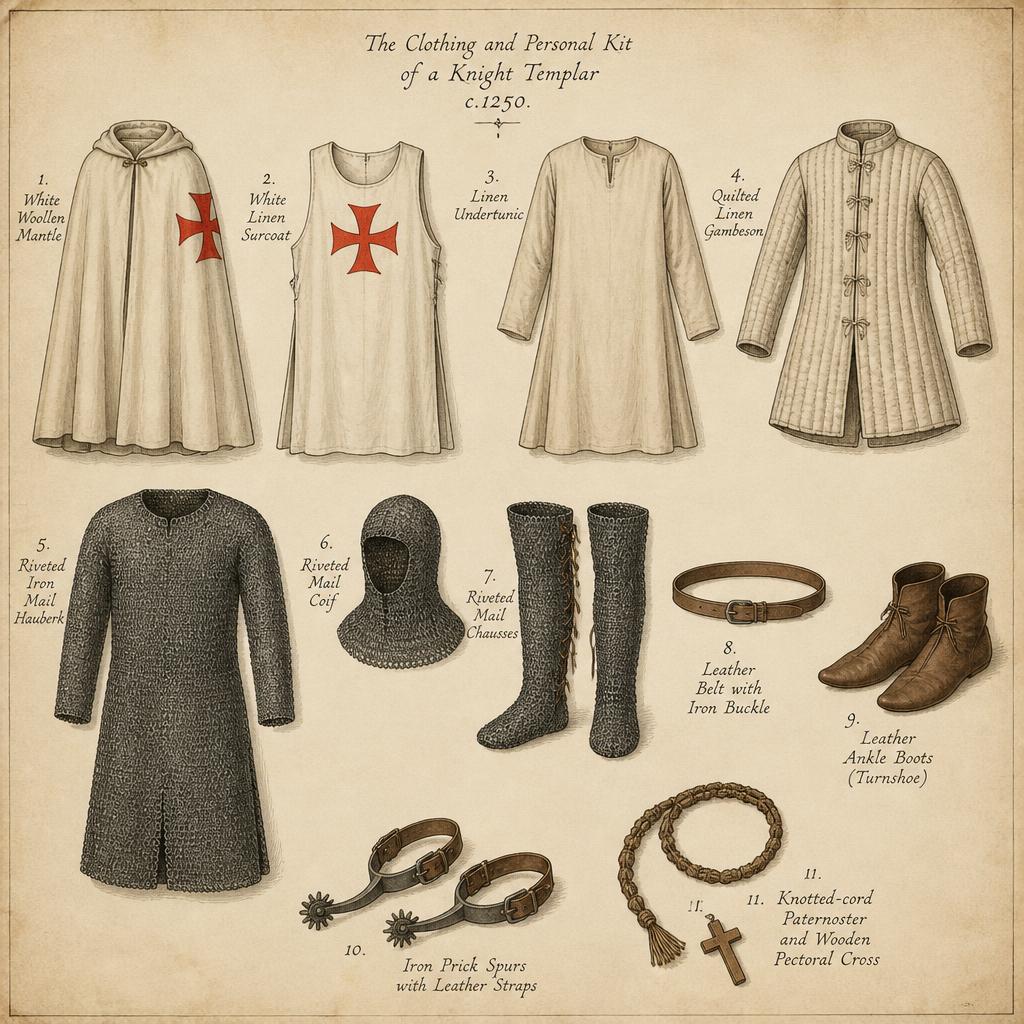
White mantle and surcoat with the red cross pattée, linen undertunic, padded gambeson, mail hauberk, coif and chausses, belt, boots, spurs and devotional items.
References & evidence
Every claim on this page is drawn from published primary sources or the standard modern scholarship on the Order of the Temple. The most important are listed below with the specific points they support. Where an attribution is traditional rather than certain, that is stated plainly.
Primary sources
- The Primitive Rule of the Templars (Latin, c.1129), issued at the Council of Troyes. Sets out the habit, tonsure and beard, prohibition on fur other than lambskin, dietary rules (meat three times a week), ban on pointed shoes and laced garments, and the requirement that brothers never travel alone. English translation in J.M. Upton-Ward, The Rule of the Templars (Boydell, 1992).
- The French Rule / Retrais (mid-13th century). The statutes and hierarchical articles giving the detailed allocation of horses (three warhorses and a pack animal per knight; one horse per sergeant in peacetime, two on campaign — Retrais §§138–141), arms and camp equipment. Also in Upton-Ward, 1992.
- Papal bull Milites Templi (1144) and the traditionally cited grant of Pope Eugenius III in 1147 authorising the red cross on the mantle. The 1147 date is repeated by almost all modern scholars but rests on the later chronicle of William of Tyre rather than a surviving bull — see Barber (2006), p.65, and Nicholson (2001), p.42.
- Trial of the Templars (1307–1312). The interrogation records describe brothers' daily dress, mantles and reception ceremonies in detail. Edited by Barber & Bate, The Templars: Selected Sources (Manchester UP, 2002).
- Report of Prior Philip de Thame to the Grand Master, 1338 (ed. L.B. Larking, Camden Society, 1857). Post-suppression Hospitaller survey listing the former Templar commanderies in Wales and their goods.
Key modern scholarship
- Malcolm Barber, The New Knighthood: A History of the Order of the Temple(Cambridge UP, 1994) — the standard academic history; chapter 8 covers organisation, dress and arms.
- Malcolm Barber, The Trial of the Templars (2nd edn., Cambridge UP, 2006).
- Helen J. Nicholson, The Knights Templar: A New History (Sutton, 2001) — accessible and up to date on the habit, sergeants and daily life.
- Helen J. Nicholson, The Everyday Life of the Templars (Fonthill, 2017) — focused on the western preceptories, including Britain.
- David Nicolle, Knight Templar 1120–1312 (Osprey Warrior 91, 2004) — illustrated reconstruction of arms and armour based on manuscript and archaeological evidence.
- William Rees, A History of the Order of St. John of Jerusalem in Wales and on the Welsh Border (Cardiff, 1947) — the standard treatment of the Welsh preceptories, including their Templar predecessors at Slebech, Llanmadoc and elsewhere.
What is certain, and what isn't
- Well documented: the white mantle for knights, black or brown for sergeants; the red cross worn on the left shoulder from the mid-12th century; the tonsure and beard; the equipment allowances in the French Rule; the general shape of European mail armour, great helms and swords in the 12th–13th centuries.
- Traditional but not proven from a single surviving document: the exact date of 1147 for the grant of the red cross, and the precise shape of the cross itself. The splayed cross pattée is the form shown on Templar seals and the Chinon parchment and is the one used almost universally in modern reconstructions, but plain Latin and Greek crosses appear on some contemporary depictions too.
- Reconstructed by analogy: no complete Templar mantle, surcoat or piece of armour survives. The illustrations here follow the consensus reconstruction used by Barber, Nicholson and Nicolle, cross-checked against contemporary manuscript illumination (e.g. the Chronica Majora of Matthew Paris, c.1240–1259), military-order effigies in Britain, and archaeological finds of arms of the period.
- The Welsh evidence: no image or effigy of an individual Welsh Templar survives. What we know of the brothers at Slebech, Llanmadoc, Cheriton and the Gower granges comes from charters, royal surveys and the 1338 Hospitaller report — see the Sources page for the full list.