Gower
St Madoc's Church, Llanmadoc
Templar, later Hospitaller
The Gower's Templar church — a small medieval church at the tip of the peninsula, held as a Templar manor and continued by the Hospitallers after 1312 as a dependency of Slebech.
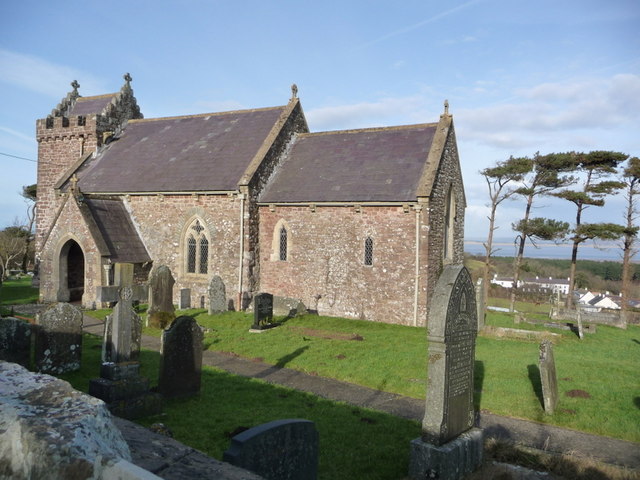
St Madoc's Church at Llanmadoc, at the north-western tip of the Gower peninsula, stands on land held by the military orders through the late medieval centuries. Local tradition — long recorded in the parish and repeated by the Victorian historians of Gower — remembers the manor as a Templar possession, granted to the order in the twelfth century along with the neighbouring parish of Llanddewi and worked as an outlying estate of the Welsh preceptory at Slebech in Pembrokeshire. Of all the Welsh sites, this is probably the strongest Templar association on the ground.
When the Templars were suppressed in 1312 their Welsh holdings passed intact to the Knights Hospitaller of St John of Jerusalem, and Llanmadoc appears explicitly in the Hospitallers' 1338 survey as a member of Slebech commandery. Under both orders the church and its glebe served the same practical purpose: sheep pasture on the limestone plateau, salt-marsh grazing at Whiteford, fisheries in the Burry inlet and a sheltered landing that let the brethren move wool and hides by sea to their houses across the Bristol Channel.
Llanmadoc is also one of the very few places in Wales where named Templars are known to have actually lived. When Edward II acted on the papal orders against the order, the sheriff was instructed in 1308 to arrest the Templar brothers resident at the Gower manor — a small, unromantic detail that nevertheless puts flesh-and-blood knights on this hillside above the Burry inlet, rather than the vague estate-holders of the charter rolls.
The little cruciform church you see today — thick stone walls, a squat saddleback tower, a scatter of early Christian inscribed stones set into the porch — is essentially the medieval fabric the orders knew, restored in the nineteenth century by the antiquarian rector J. D. Davies. Inside and around the building are several medieval cross slabs and carved stones; none can be tied by documentary evidence to a specific Templar knight, but local tradition has long associated some of them with the order, and they are exactly the kind of plain incised crosses the brethren would have known. The pattern of stone-walled fields around the church still traces the medieval organisation of the manor.
Visiting
Llanmadoc is at the end of the B4295 on north Gower. There is a small car park beside the church of St Madoc; the Whiteford Burrows nature reserve — old Templar and Hospitaller grazing ground — is a short walk down the lane.
Coordinates: 51.6072°N, 4.2647°W